
Jay Sklar

Jay Sklar is an American Old Testament scholar and theologian within the Reformed evangelical tradition, known for his deep commitment to the authority of Scripture and his skill in making the Hebrew text both clear and compelling for modern readers. He serves as Professor of Old Testament and Academic Dean at Covenant Theological Seminary in St Louis, where his teaching and writing have shaped a generation of pastors and teachers in faithful biblical exposition.

Sklar’s most significant contribution lies in his careful work on the book of Leviticus, culminating in his volume for the Zondervan Exegetical Commentary on the Old Testament series. His scholarship unites linguistic precision with theological insight, allowing the structure and message of Scripture to speak with clarity and warmth. Beyond Leviticus, his writings and lectures consistently reveal how God’s holiness and grace are interwoven through the entire biblical narrative.

Respected for both academic depth and pastoral sensitivity, Sklar exemplifies the kind of scholarship that serves the church as well as the academy. Notable works include Leviticus (Zondervan, 2023) and numerous essays and studies on holiness, covenant, and worship in the Old Testament.

Theological Perspective: Broadly Evangelical

Jay Sklar

Jay Sklar is an American Old Testament scholar and theologian within the Reformed evangelical tradition, known for his deep commitment to the authority of Scripture and his skill in making the Hebrew text both clear and compelling for modern readers. He serves as Professor of Old Testament and Academic Dean at Covenant Theological Seminary in St Louis, where his teaching and writing have shaped a generation of pastors and teachers in faithful biblical exposition.

Sklar’s most significant contribution lies in his careful work on the book of Leviticus, culminating in his volume for the Zondervan Exegetical Commentary on the Old Testament series. His scholarship unites linguistic precision with theological insight, allowing the structure and message of Scripture to speak with clarity and warmth. Beyond Leviticus, his writings and lectures consistently reveal how God’s holiness and grace are interwoven through the entire biblical narrative.

Respected for both academic depth and pastoral sensitivity, Sklar exemplifies the kind of scholarship that serves the church as well as the academy. Notable works include Leviticus (Zondervan, 2023) and numerous essays and studies on holiness, covenant, and worship in the Old Testament.

Theological Perspective: Broadly Evangelical

Reset

Jonah, ESV Expository Commentary

Mid-levelBusy pastors, Pastors-in-trainingStrong recommendation
8.2
Author: Jay Sklar
Bible Book: Jonah
Publisher: Crossway
Theological Perspective: Broadly Evangelical
Resource Type: Commentary

Summary

In Jonah, ESV Expository Commentary, Jay Sklar helps us read Jonah as more than a children’s story. He keeps the narrative pace, draws out the prophet’s spiritual contradictions, and shows how the book confronts our narrowness with the Lord’s mercy. Volume 7.

We are shown how scenes fit together, how the repeated words work, and how the closing question is meant to linger in the conscience of the church.

Why Should I Own This Commentary?

We should own this volume when we want help preaching narrative with care. It presses us to observe, to follow the story’s turning points, and to avoid moralising that misses the book’s sharp edge.

The commentary is helpful in application. We are guided to speak honestly about resentment, self righteousness, and the hard lesson of sharing God’s compassion.

It also serves mission shaped preaching, because it keeps the Lord’s freedom and kindness at the centre, rather than treating Jonah as the hero.

Closing Recommendation

We recommend Jonah, ESV Expository Commentary for pastors and teachers who want a mid level companion that is clear, faithful, and geared for proclamation. It is a strong aid when we want sermons that humble us, and that lift our eyes to the Lord who delights to save.

As pastoral next steps, we can visit the Bible Book Overview, browse Top Recommendations, and use the Reformed Commentary Index to build a wiser working library.

🛒
Purchase here

Exodus, ESV Expository Commentary

Mid-levelBusy pastors, Pastors-in-trainingStrong recommendation
8.2
Author: Jay Sklar
Bible Book: Exodus
Publisher: Crossway
Theological Perspective: Broadly Evangelical
Resource Type: Commentary

Summary

In Exodus, ESV Expository Commentary, Jay Sklar helps us read Exodus with care and confidence, and the wider ESV Expository Commentary framework keeps us moving from explanation toward proclamation. Volume 1.

We are given a workable blend of explanation and pastoral direction. It is the kind of volume we can keep open on the desk while preparing sermons, studies, and teaching plans.

We appreciate the way it avoids gimmicks. It keeps the emphasis on God’s character, God’s promises, and God’s demands, then draws out implications for worship and obedience.

Why Should I Own This Commentary?

We should own this volume because it helps us prepare sermons with fewer shortcuts. It points us back to context, highlights the flow of argument and narrative, and keeps the centre of the passage in view.

We benefit from the way it keeps gospel contours visible. It does not force Christ into every paragraph, but it does keep the promises, patterns, and purposes of God moving toward their fulfilment.

As part of a working library, it pairs well with more detailed resources. It keeps us oriented, and it stops us getting lost in detail that never reaches the congregation.

Closing Recommendation

We recommend this volume for pastors and teachers who want an accessible, Scripture shaped guide to Exodus. It is especially useful when we need help with structure, emphasis, and faithful application.

As pastoral next steps, we can visit the Bible Book Overview, browse Top Recommendations, and use the Reformed Commentary Index to build a wiser working library.


🛒
Purchase here

Exodus

Mid-levelBusy pastors, General readers, Pastors-in-trainingTop choice
8.5
Author: Jay Sklar
Bible Book: Exodus
Publisher: IVP
Theological Perspective: Broadly Evangelical
Resource Type: Commentary

Summary

We find Sklar’s work on Exodus in the Tyndale Old Testament Commentaries series a steady guide for understanding what the text says and what it means. It keeps the main line of the book clear, while still slowing down over the points that often trip us up in preaching and teaching.

The best of this kind of commentary is its balance. We are given enough orientation to read Exodus responsibly, then we are brought back to the passage itself, section by section, with an eye on the theological stakes and the shape of the argument.

Why Should I Own This Commentary?

We should own this volume when we need a clear mid level guide that is both teachable and usable. It supports our movement from careful exegesis toward proclamation, and it helps us avoid both thin readings and needless complexity.

We especially appreciate the way it highlights recurring themes and repeated words, helping us preach paragraphs rather than isolated phrases. It also tends to keep application tethered to the text, which is a gift when Exodus is familiar and we are tempted toward shortcuts.

In practice, it sits well alongside a more technical commentary. We can do our heavier lifting elsewhere when needed, then return here for clarity, theological orientation, and a steady sense of what we should say to the church from Exodus.

Closing Recommendation

We recommend this as a strong mid level commentary for preaching and teaching Exodus. It will not answer every specialist question, but it consistently helps us handle the text with integrity and bring its truth to bear on the people entrusted to us.

As pastoral next steps, we can visit the Bible Book Overview, browse Top Recommendations, and use the Reformed Commentary Index to build a wiser working library.


🛒
Purchase here

Leviticus

AdvancedAdvanced students / scholars, Busy pastors, Pastors-in-trainingTop choice
9.2
Author: Jay Sklar
Bible Book: Leviticus
Publisher: Zondervan
Theological Perspective: Broadly Evangelical Reformed
Resource Type: Commentary

Summary

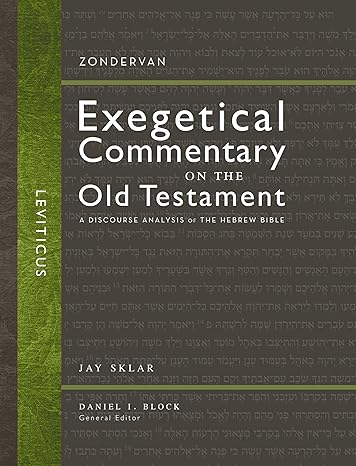
The commentary in question is Leviticus by Jay Sklar, part of the Zondervan Exegetical Commentary on the Old Testament (ZECOT) series, published by Zondervan in 2023. This volume spans approximately 864 pages.
In terms of approach, Sklar provides for each pericope a Hebrew-English translation, a detailed exegetical outline of the passage, commentary that engages the Hebrew text (though not requiring full proficiency), and a “Canonical and Theological Significance” section that bridges the ancient text with contemporary pastoral concerns. The structure places discourse analysis, textual structure and literary context at the forefront, reflecting the series’s emphasis on how an author says something as well as what is said.

It is aimed primarily at pastors, Bible-teachers, ministry leaders and serious students of Scripture who are willing to engage with the Hebrew text and desire a trustworthy resource for preaching and teaching. While technical in places, it strives for accessibility. :

Why Should I Own This Commentary?

First, its strengths lie in its combination of rigorous exegesis and a pastor-friendly framework. Sklar does not shy away from Hebrew, syntax and discourse analysis, yet the commentary remains readable and oriented toward preaching and teaching. Reviewers note that whereas many commentaries on Leviticus become heavy in technical minutiae, this commentary retains the “why it matters” dimension for church ministry. For you as a pastor and Bible-teacher, this means a deeper grasp of the text’s structure, especially around key Levitical concepts like holiness, atonement, presence and purity—and the capacity to craft sermons that honour the text without being dry or inaccessible.

Secondly, the volume’s theological content is commendable from a Reformed vantage. Sklar consistently points to the presence of a holy God dwelling among a redeemed people, the necessity of substitutionary atonement (implicit in Leviticus’s sacrifices) and the forward-looking purpose of the law in covenant-community formation. While he does not always explicitly carry out a full covenantally, Reformed theology, the framework supports it well. This makes the commentary valuable for sermon preparation: the “Canonical and Theological Significance” sections often give you ready-to-go homiletic headings and theological insights rooted in the original context.

Thirdly, in practical usefulness this volume excels. Given how many find the Book of Leviticus difficult to preach, this commentary gives you clarity on structure and purpose, why the rituals matter, what they teach this covenant, people about God and neighbour, and then invites modern application. Reviewers emphasise that the layout (translations + outline + commentary + application) supports sermon-craft. For the busy pastor you get both depth and usable scaffolding.

Of course no commentary is perfect: some readers with little Hebrew may find parts dense, and there are times when the theological motifs (e.g., sin-wrath-atonement) could be more coherently developed. A reviewer noted that the motif of law functioning to ‘protect the people from divine wrath’ was touched on but not fully integrated. So while this is an excellent resource, it still requires you to engage with the text and draw out the connections pastorally.

Closing Recommendation

In our judgment, this commentary is strongly recommended for pastors, teachers and serious students who plan to preach or teach through the Book of Leviticus. If your aim is to do more than survey the book and instead to guide your congregation through it faithfully, honouring the Hebrew text, engaging its theological weight and crafting relevant application—then this belongs on your shelf.

For those who only need a very brief introduction, or have limited Hebrew interest, a more summary commentary might suffice (and this work may feel detailed). But if you value a high-quality Reformed-friendly resource that marries sound exegesis with homiletic insight, then we regard this as one of the better recent options for Leviticus.

As pastoral next steps, we can visit the Bible Book Overview, browse Top Recommendations, and use the Reformed Commentary Index to build a wiser working library.


🛒 Purchase here