
Read, Re-read, And Re-Read (…And Keep Reading)
The first habit of faithful exposition.
Before we outline, before we interpret, before we reach for a commentary, we must read the passage. And then we must read it again. Repeated reading is the most overlooked discipline in sermon preparation, yet it is the foundation upon which all faithful exposition rests.
The Preacher Must Know the Passage
Good preaching begins long before pen touches paper. It begins when the preacher sits with the text, unhurried and attentive. We are not scanning for ideas. We are submitting ourselves to God’s voice.
Reading the passage five to ten times is not excessive. In fact, it is often the moment when the fog begins to lift. By the sixth reading, the text starts to settle in the mind. By the eighth, familiar words feel newly weighty. By the tenth, we start to notice what we never saw at the start.
Re-reading is the means by which the preacher begins to inhabit the passage. We feel its tone, sense its movement, and absorb its burden.
Silent Reading and Reading Aloud
Both forms of reading serve the preacher in different ways, and using both unlocks the shape of a passage.
- Silent reading exposes structure, repeated words, logic, and the flow of thought.
- Reading aloud reveals tone, pace, emphasis, and emotional weight.
Alternating between the two means we listen with both the eye and the ear. Silent reading sharpens observation. Reading aloud engages the heart and imagination. Together, they help us hear Scripture as the congregation will hear it on Sunday.
The A3 Method: Immersion on Paper
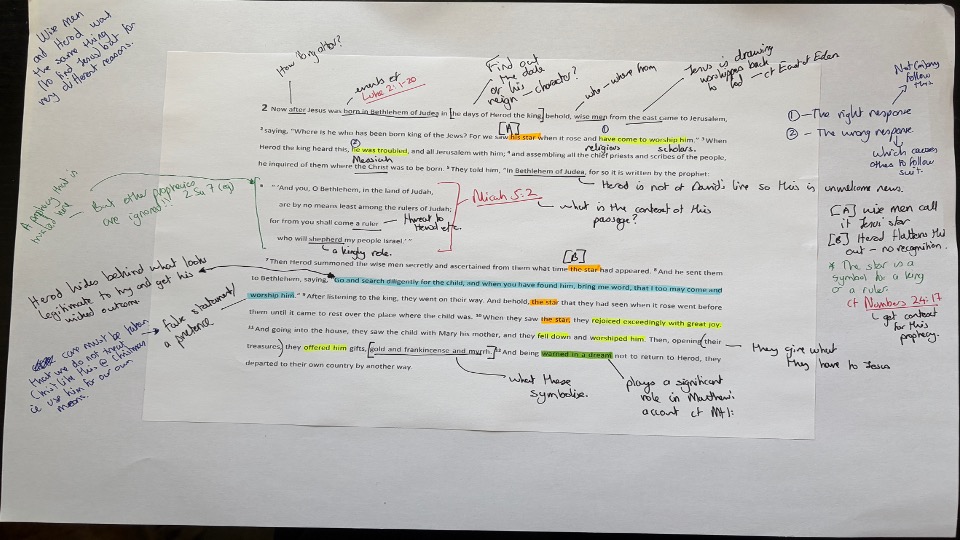
I begin by printing the passage on an A3 sheet. The space matters. It gives room to think freely, to question honestly, and to write without constraint.
As I read and re-read, I mark the text generously:
- highlighting repeated words and themes
- circling key verbs and imperatives
- noting imagery, covenant echoes, or Old Testament patterns
- drawing arrows to show flow and movement
- writing questions in the margins as they arise
Nothing is too small or too rough to write down. Questions about grammar, tension, emphasis, or intertextual connections all belong on the page. This is not the moment for tidy thoughts. It is the moment for honest discovery.
Over time, that A3 sheet becomes a map of the passage. Personal. Messy. Lived in. A testimony that the preacher has listened long before he speaks.
Why This Matters
Repeated reading is not a technique. It is an act of reverence. We are handling the Word of the living God, and we cannot preach it faithfully until we have listened faithfully.
Before we analyse structure, trace themes, or explore biblical theology, we must let the text wash over us. This habit guards us from inserting our own ideas and helps us preach what is truly there. In a Reformed understanding of preaching, this is essential. The authority lies in the text, not in the preacher. Re-reading anchors everything else in that conviction.
The Fruit of Re-Reading
When we read and read again:
- the text becomes a companion throughout the week
- our prayers become shaped by the passage’s burden
- our outlines grow organically from what God has said
- our preaching becomes clearer, warmer, and more confident
Re-reading may feel slow, but it is never wasted. It is the soil in which faithful exposition flourishes.